Monthly Marketing Plan NZ: Straight-Up Guide for Busy Owners
28 August 2026 · 17 min read

Most Kiwi business owners are essentially throwing bank notes into a digital wind tunnel and hoping for the best. You've likely felt the sting of wasting money on ads that don't work. It’s hard to stay confident without a solid monthly marketing plan nz to guide your decisions. If you feel like you're just shouting into the void on social media, you’re not alone. Marketing shouldn't be a guessing game that drains your account.
You don't need a 50-page strategy or corporate fluff that ends up in the bin. You need a rhythm that actually delivers results. This guide is your straight-up roadmap to building a marketing habit that drives sales without the nonsense. We’ll break down a simple, actionable checklist to help you find consistent leads. It's time to stop the guesswork and start growing your business with total confidence. We will look at how to prioritise high-impact actions over busy-work so you can finally see a real return on your spend.
Key Takeaways
- Learn how to build a monthly marketing plan nz that focuses on high-impact sales rather than just making noise.
- Discover why a "living roadmap" is the only way to avoid the "set and forget" trap that wastes your hard-earned budget.
- Find out how to navigate the unique New Zealand business calendar, from surviving the summer slump to winning the February rush.
- Identify the "Busy Owner Trap" and learn how to simplify your tech stack to keep your marketing consistent when life gets hectic.
- Understand how a Marketing Director Report and Strategy Session can provide the professional clarity you need without an expensive in-house hire.
What is a Monthly Marketing Plan NZ Owners Actually Need?
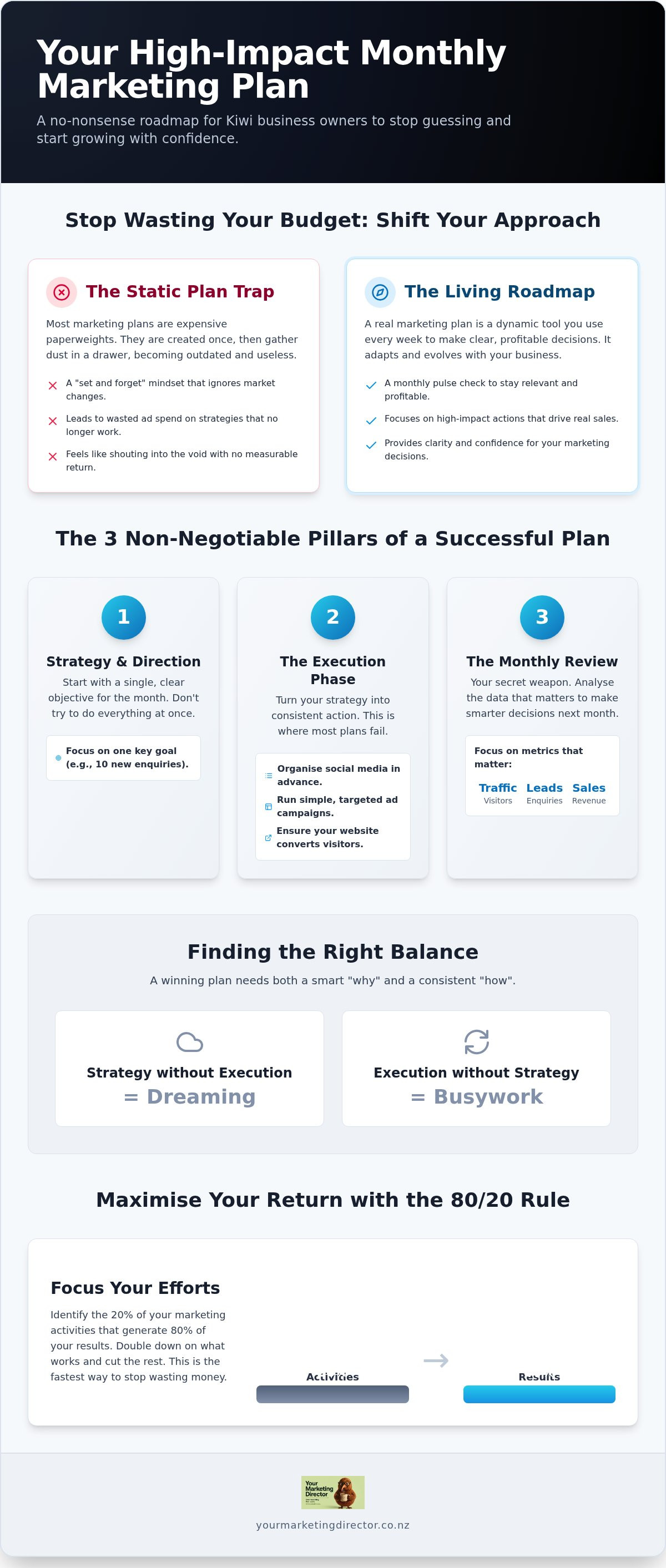
Most marketing plans are expensive paperweights. They sit in a drawer gathering dust or live as a PDF that nobody ever opens. A real monthly marketing plan nz isn't a 50-page manifesto. It's a living roadmap. It’s a tool that helps you make decisions every Monday morning without the mental fog. If your plan doesn't tell you exactly what to do this week, it's not a plan; it's a wish list.
Kiwi business owners often fall into the "set and forget" trap. You set up a Google Ad or a Facebook post and hope it works forever. It won't. Markets shift, competitors move, and your customers' habits change. Relying on a strategy you wrote three years ago is like using a map of Auckland from the 1970s to find a new cafe in Britomart. You need a monthly pulse check to stay relevant and profitable.
Strategy vs. Execution: Why You Need Both
Think of strategy as the "why" and execution as the "how". If you look at the academic definition of what marketing is, it often sounds complicated. In the real world, it's just about connecting what you sell with someone who needs it. Strategy is knowing who those people are and why they should choose you over the guy down the road. Execution is actually sending the email or launching the ad.
Having one without the other is a recipe for a wasted budget. Strategy without execution is just dreaming. Execution without strategy is just being busy. A solid monthly marketing plan nz balances long-term brand building with the short-term need for sales. You need to keep the lights on today while making sure people still remember your name next year.
The "Straight-Talk" Approach to Planning
Let's cut through the corporate fluff. You'll hear people talk about "lead generation" and "conversion rates". In plain English, lead gen means getting people to raise their hand and say they're interested. Conversion means they actually put money in your bank account. Developing a monthly marketing plan nz that actually works means being honest about your numbers. If you only have $1,000 to spend, don't try to be everywhere at once.
Success comes from the 80/20 rule. Focus on the 20% of activities that drive 80% of your results. This usually means picking one or two channels and doing them well. This is where a Marketing Director Report becomes your best friend. It acts as a monthly pulse check, showing you exactly what worked and what didn't. It strips away the mystery and gives you the confidence to double down on what’s actually making you money.
The 3 Non-Negotiables of an NZ Monthly Marketing Plan
A marketing plan that actually works doesn't need to be fancy. It just needs to be consistent. For most Kiwi businesses, success comes down to three core pillars that keep the engine running. Without these, you're just busy, not productive. You need a monthly marketing plan nz that balances getting noticed today with building a reputation for tomorrow. Let's look at the three things you can't afford to skip.
Pillar 1: Strategy and Direction
Don't try to boil the ocean. A successful monthly marketing plan nz starts with a single, clear objective. Maybe you want 10 new enquiries this month. Perhaps you need to move specific stock or fill a gap in your calendar. Write it down in one sentence. This keeps you focused when the daily grind gets in the way. You can't pull every lever at once. Decide if this month is about SEO, social media, or paid ads. If you are unsure how to create a marketing plan that actually sticks, start with that one goal and work backwards.
Pillar 2: The Execution Phase
Execution is where most plans die. You start the month with good intentions. Then a client calls, a staff member is sick, and suddenly it's the 20th and you haven't posted a thing. You need to organise your social media in advance to avoid the "what do I post today?" panic. Set up simple ad campaigns on Meta or Google that don't require a degree to manage. Focus on reaching people who are actually in your service area. Finally, check your website. If it isn't turning visitors into leads, all the traffic in the world won't help your bank balance. If you're feeling stuck on the "how", a Report + Strategy Session can help you map out these steps clearly.
Pillar 3: The Monthly Review
The review is your secret weapon. Most owners ignore the numbers because they look like a jumble of jargon. Ignore vanity metrics like "likes" or "reach". They feel good, but they don't pay the GST. Focus on three metrics that actually matter: traffic, leads, and sales. Use your review to see what worked. If an ad bombed, turn it off. If an email campaign brought in three new jobs, do more of that next month. This is how you stop wasting money and start seeing a real return on your spend.
Don't forget your email list during this phase. It is your most valuable asset because you own it. Social platforms can change their algorithms tomorrow, but your list stays with you. Nurturing those leads is what turns a one-time click into a loyal customer who comes back again and again.
Building Your 12-Month Roadmap: One Month at a Time
A 12-month roadmap isn't about predicting the future with a crystal ball. It’s about knowing the rhythm of the New Zealand market and planning your moves accordingly. Your monthly marketing plan nz needs to breathe. It should change as the seasons do. In January, most of the country is at the beach or firing up the barbecue. In February, everyone is back at their desks with a "let's do this" attitude. If you use the same tactics in both months, you're wasting your hard-earned money.
Think about the big milestones that affect your specific industry. If you are in the ag-sector, Fieldays in June is a non-negotiable. If you are a local Tauranga business, you might focus on regional expos or the summer tourism surge. Mapping these out early means you aren't scrambling for content the week before a major event. It gives you the space to be proactive rather than reactive.
Quarterly Themes and Seasonal Focus
Divide your year into quarters to make the workload manageable. Q1 is your New Year reset. Use the quiet start of January to audit your website or polish your brand message. By February, you need to be hitting the ground running to catch the "back to business" rush. This is when enquiries usually spike as people look to tick off their new projects.
Q2 is about mid-year momentum. It is a great time for winter promotions or focusing on educational content that builds trust. In Q3, you are in the winter grind, but you are also looking ahead. This is when you start prepping for the Christmas rush and end-of-year sales. If you wait until December to plan your holiday marketing, you have already lost the race. A monthly marketing plan nz ensures you are always one step ahead of the calendar.
Managing Your Marketing Budget Wisely
Deciding where to put your money is the hardest part of planning. You have to balance paid reach with long-term growth. Ads on Meta or Google find customers fast, while SEO and email marketing build a foundation that lasts. Don't fall for "affordable" marketing packages that promise the world for next to nothing. These often end up costing more in the long run because they fail to deliver real leads. Quality execution pays for itself.
Always keep a "flex fund" in your budget. This is a small amount of cash set aside for unexpected opportunities. Maybe a local event pops up that fits your brand perfectly. Or perhaps a specific social post starts performing well and needs a little extra ad spend to go further. Having this flexibility means you can jump on opportunities without blowing your entire plan. It keeps your marketing agile and responsive to the real world.
Common Pitfalls: Why Kiwi Small Businesses Struggle with Consistency
Consistency is the hardest part of marketing. Most Kiwi owners start with a hiss and a roar in February, but by May, the social media pages are ghost towns. The "Busy Owner Trap" is the biggest culprit. When you're flat out with jobs, marketing is the first thing to get binned. But stopping your marketing when you're busy just guarantees a quiet month later on. A solid monthly marketing plan nz helps you maintain a baseline even when you're under the pump. It ensures your pipeline stays full while you're focused on delivery.
Then there's the tech trap. You don't need a dozen subscriptions to succeed. You just need a few tools that talk to each other. Chasing every new platform like TikTok or Threads without a plan is just shouting into a different void. It's exhausting and rarely leads to sales. Without a regular strategy session to check your direction, you're working in a vacuum; this is a fast track to burnout. You need a clear roadmap to stop the "shiny object" syndrome from draining your time and budget.
The Danger of DIY Marketing
Doing it yourself feels like it saves money. In reality, it often costs more in lost opportunities. If you're spending five hours a week wrestling with Meta Ads instead of billing clients, you're losing money. With the 2026 changes to the Fair Trading Act increasing penalties for misleading ads, the risk of getting it wrong is higher than ever. There's a middle ground where you handle the basics but get an expert to set the roadmap. Getting a Marketing Director Report gives you that professional oversight without the cost of a full-time hire. It's about working smarter, not just harder.
Overcoming the "Jargon Barrier"
Stop listening to "gurus" and start listening to your customers. Most small business owners get overwhelmed by terms like "algorithmic optimisation" or "programmatic buying". It's all fluff. Focus on straight-talk advice that makes sense for your specific industry. You need a monthly marketing plan nz that uses plain language. If you don't understand your own reporting, you can't calculate your ROI. Simplify your metrics to traffic, leads, and sales. If those numbers aren't moving, the plan needs to change. It's about being effective, not sounding smart. When you strip away the mystery, marketing becomes just another manageable part of your business.
Getting Expert Eyes on Your Monthly Marketing Plan NZ
Sometimes you’re just too close to your own business to see the gaps. You know your trade inside out, but marketing can feel like a moving target. Getting expert eyes on your monthly marketing plan nz is the fastest way to stop the guessing and start the growing. You don't need to hire an expensive full-time manager to get results. An outsourced director gives you the high-level strategy you need at a fraction of the cost of a new salary.
The Marketing Director Report Advantage
A Marketing Director Report isn't just a bunch of confusing graphs. It’s a tailored roadmap designed for your specific business goals. It breaks down exactly where your budget is going and, more importantly, what it’s doing for your bank account. This report keeps you accountable every single month. It ensures your SEO, social media, and ad spend are all pulling in the same direction. No more wondering if your Meta Ads are actually working. You’ll have the data right in front of you in plain English.
For a business in Tauranga or anywhere else in New Zealand, this monthly pulse check is vital. It allows you to pivot quickly if a campaign isn't landing. Instead of waiting until the end of the financial year to see if you made a profit, you can adjust your tactics in real-time. It’s about having a specialist in your corner who cares about your ROI as much as you do. We focus on the numbers that actually matter to your bottom line.
Taking the Next Step for Your Business
If you are feeling overwhelmed by the "Busy Owner Trap" we mentioned earlier, a strategy session is the best investment you can make. It’s designed to clear the mental fog that comes with trying to do everything yourself. We sit down and look at the "why" before we worry about the "how". This session provides the clarity most owners are missing. It turns a messy list of ideas into a structured, actionable plan. You’ll walk away knowing exactly what to focus on over the next four weeks.
Transitioning from a reactive approach to a proactive growth strategy changes everything. It gives you back your time and reduces the stress of running a business. You deserve to feel confident that your marketing spend isn't being wasted on fluff. It’s time to get a professional roadmap that actually drives sales and enquiries. Book a strategy session with Your Marketing Director today and let's get your monthly marketing plan nz sorted with straight-up advice that works.
Ready to Stop the Marketing Guesswork?
Marketing shouldn't feel like a second job that never ends. It's about building a rhythm that keeps your pipeline full while you focus on what you do best. By now, you know that a successful monthly marketing plan nz isn't about 50-page documents or chasing every new social media trend. It’s about setting one clear goal, pulling the right levers, and reviewing the numbers that actually impact your bank balance. Consistency is your secret weapon; it's much easier to maintain when you have a clear roadmap to follow.
You don't have to navigate this alone. Our Tauranga-based team of specialists provides no-nonsense Kiwi advice to help you scale sustainably. We strip away the jargon and provide customised monthly roadmaps that take the weight off your shoulders. If you're ready for total clarity on your marketing spend, get your straight-talk Marketing Director Report here. You have the strategy. Now it’s time to take that first step and start growing your business with confidence.
Frequently Asked Questions
Do I really need a written marketing plan for a small NZ business?
Yes, because a plan kept in your head is just a wish. A written roadmap provides clarity and prevents the "Busy Owner Trap" where marketing is the first thing to drop when you're under the pump. It holds you accountable to your goals and ensures you aren't just reacting to fires. Even a simple one-page checklist is better than nothing. It keeps your team aligned and ensures every dollar spent has a specific purpose.
How much should I spend on a monthly marketing plan?
Most small businesses in New Zealand should aim to invest between 5% and 12% of their gross revenue into marketing. For growth-focused companies, this often translates to a starter budget between NZ$500 and NZ$1,500 per month. It’s better to do one or two channels well than to spread a small budget too thin across every platform. Focus on high-ROI activities like SEO or email marketing first to see a real return.
Can I manage my own monthly marketing plan or should I outsource?
You can manage the basics yourself, but outsourcing the strategy often saves you money in the long run. If you spend hours wrestling with ad settings instead of billing clients, you're losing profit. A middle-ground approach works best for many: you handle the authentic social content while a specialist manages the complex stuff like Meta Ads and SEO. This prevents burnout while ensuring your monthly marketing plan nz stays on track.
What is the most important part of a marketing plan for a Kiwi owner?
The most important part is having one clear, measurable goal for the month. Whether it’s ten new enquiries or selling out a specific product, every action should lead back to that objective. Without a focused goal, you'll find yourself chasing "shiny objects" and wasting budget on vanity metrics. A plan that doesn't drive sales is just a hobby. Focus on the 20% of activities that bring in 80% of your revenue.
How long does it take to see results from a monthly marketing plan?
You can see immediate results from paid ads, but organic growth usually takes three to six months. Google Ads can drive traffic within days of launching. However, building a sustainable brand through SEO and content marketing is a long-term game. A solid monthly marketing plan nz balances these quick wins with foundational work. Consistency is the key; if you stop too early, you lose all the momentum you’ve already built.
What is a Marketing Director Report and how does it help?
It is a professional pulse check that replaces the need for a full-time in-house hire. The report breaks down your performance in plain English, showing exactly where your leads are coming from. It acts as a roadmap, highlighting what worked and what needs to be binned. This level of oversight clears the mental fog and gives you the confidence to make informed decisions about your future spend without any of the usual corporate fluff.
Is social media enough for a monthly marketing plan in NZ?
No, relying solely on social media is risky because you don't own those platforms. Algorithms change constantly, and your reach can disappear overnight. A robust plan should include an email list and a website that actually converts visitors into leads. Use social media to find people, but bring them back to your own "digital property". This ensures your business remains resilient even if a platform like Facebook or Instagram makes a major change.
How often should I review my marketing strategy?
You should review your results every month and your overall strategy every quarter. A monthly review allows you to tweak your ads and social posts based on real data. A quarterly deep dive helps you adjust for seasonal shifts in the New Zealand market, such as the Christmas rush or the winter slowdown. Regular check-ins prevent you from drifting off course and ensure your budget is always working its hardest for you.
Frequently Asked Questions
Yes, because a plan kept in your head is just a wish. A written roadmap provides clarity and prevents the "Busy Owner Trap" where marketing is the first thing to drop when you're under the pump. It holds you accountable to your goals and ensures you aren't just reacting to fires. Even a simple one-page checklist is better than nothing. It keeps your team aligned and ensures every dollar spent has a specific purpose.
Most small businesses in New Zealand should aim to invest between 5% and 12% of their gross revenue into marketing. For growth-focused companies, this often translates to a starter budget between NZ$500 and NZ$1,500 per month. It’s better to do one or two channels well than to spread a small budget too thin across every platform. Focus on high-ROI activities like SEO or email marketing first to see a real return.
You can manage the basics yourself, but outsourcing the strategy often saves you money in the long run. If you spend hours wrestling with ad settings instead of billing clients, you're losing profit. A middle-ground approach works best for many: you handle the authentic social content while a specialist manages the complex stuff like Meta Ads and SEO. This prevents burnout while ensuring your monthly marketing plan nz stays on track.
The most important part is having one clear, measurable goal for the month. Whether it’s ten new enquiries or selling out a specific product, every action should lead back to that objective. Without a focused goal, you'll find yourself chasing "shiny objects" and wasting budget on vanity metrics. A plan that doesn't drive sales is just a hobby. Focus on the 20% of activities that bring in 80% of your revenue.
You can see immediate results from paid ads, but organic growth usually takes three to six months. Google Ads can drive traffic within days of launching. However, building a sustainable brand through SEO and content marketing is a long-term game. A solid monthly marketing plan nz balances these quick wins with foundational work. Consistency is the key; if you stop too early, you lose all the momentum you’ve already built.
It is a professional pulse check that replaces the need for a full-time in-house hire. The report breaks down your performance in plain English, showing exactly where your leads are coming from. It acts as a roadmap, highlighting what worked and what needs to be binned. This level of oversight clears the mental fog and gives you the confidence to make informed decisions about your future spend without any of the usual corporate fluff.
No, relying solely on social media is risky because you don't own those platforms. Algorithms change constantly, and your reach can disappear overnight. A robust plan should include an email list and a website that actually converts visitors into leads. Use social media to find people, but bring them back to your own "digital property". This ensures your business remains resilient even if a platform like Facebook or Instagram makes a major change.
You should review your results every month and your overall strategy every quarter. A monthly review allows you to tweak your ads and social posts based on real data. A quarterly deep dive helps you adjust for seasonal shifts in the New Zealand market, such as the Christmas rush or the winter slowdown. Regular check-ins prevent you from drifting off course and ensure your budget is always working its hardest for you.